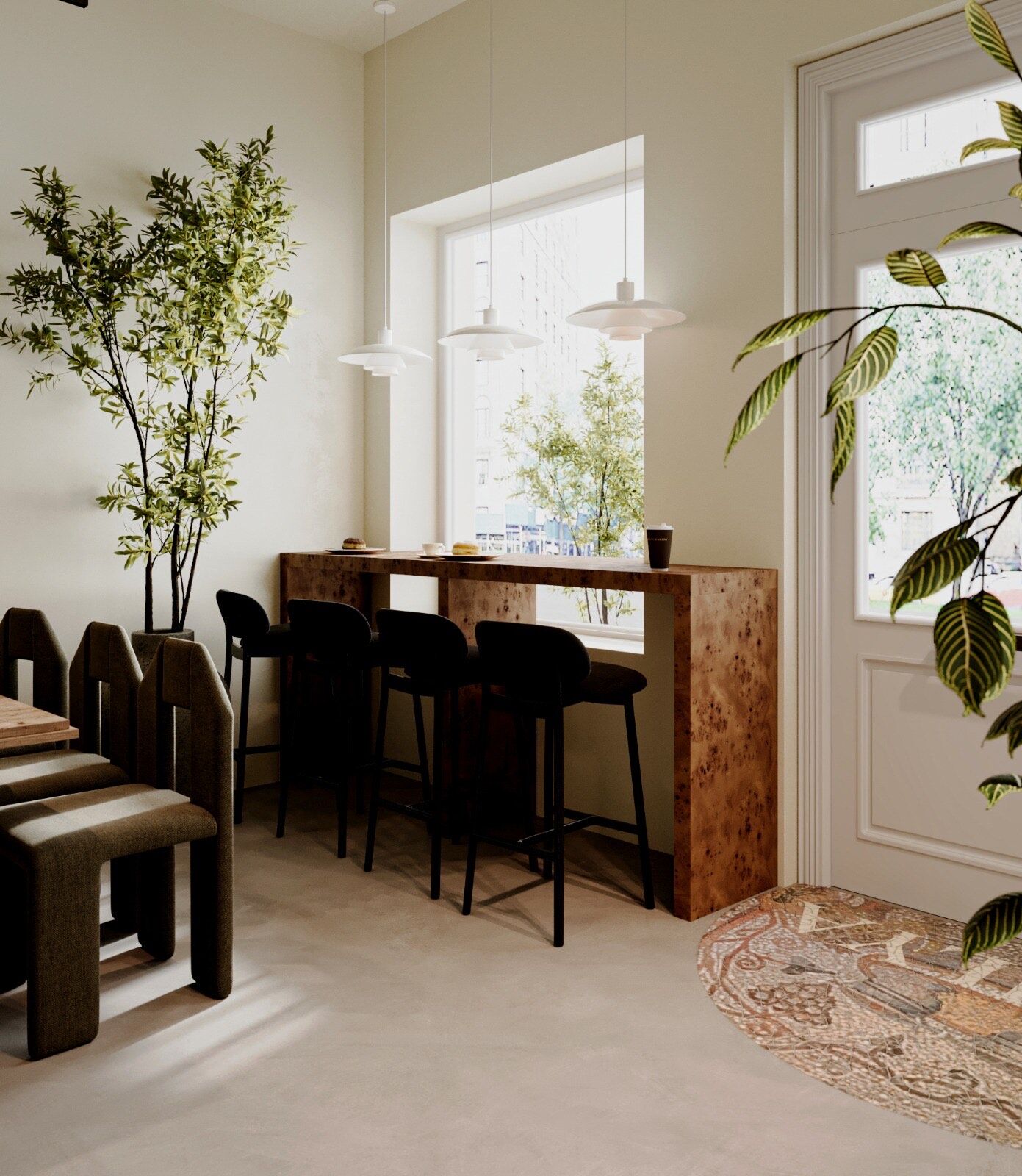
A coffee shop is the smallest storefront in hospitality that still hides a full commercial kitchen behind the counter. That is why the cost to open a coffee shop in NYC catches people off guard: the room is small, but almost nothing inside it is cheap. The honest answer is a range, and the range depends first on which kind of shop you are opening.
The short answer on the cost to open a coffee shop in NYC
Published planning figures put a brick-and-mortar café with seating between $80,000 and $400,000, rising past $755,000 once the concept adds a full kitchen and food service. A kiosk or mobile cart sits lower, roughly $50,000 to $100,000, and a drive-thru-only build runs $100,000 to $300,000. Format sets the floor before location does anything.
Then apply the New York correction. Turner & Townsend's 2025 market report ranks the city first in the world for construction cost, at $5,744 per square meter, about $534 per square foot, with construction labor at $131.40 an hour. National café figures are a floor here, not a midpoint. A working planning number for a modest sit-down shop in Brooklyn or Queens, 600 to 900 square feet, lands in the low-to-mid six figures once the room, the equipment, the licenses, and a few months of reserves are all counted. A grab-and-go counter with little seating can come in well under that. The rest of this piece is the line items that decide where inside the range you land.
Build-out is the number that moves
Construction is the largest and least predictable line. National coffee-shop guides put build-out at $100 to $300 per square foot; the New York figure, per the ranking above, runs closer to $534. On a 700 square foot shop, that spread alone is the difference between a $70,000 job and one past $370,000.
The variance is not markup. It is the condition of the space you inherit. A former café already vented, plumbed, and wired is a different project from raw retail that needs a grease interceptor, make-up air, and a new electrical service. This is also where grab-and-go and sit-down separate. A counter-service shop with a few stools carries less seating area and lighter mechanical loads; a sit-down café pays for a dining room, its finishes, and often a real kitchen.
There is a reason the per-foot number climbs as the room shrinks. A food-service space packs commercial exhaust, make-up air, grease handling, fire suppression, and heavy electrical into a small footprint, and the cost of those systems does not fall much when the floor plate does. A 700 square foot café can price higher per foot than an office ten times its size, because the mechanical work is nearly fixed and the room it hides in is not. The smaller the shop, the more of every dollar goes to systems the guest never sees. Design's share of the build-out is smaller than founders expect and more decisive than they think, a subject we treat on its own in what café interior design costs in New York.
Equipment is the predictable half
Equipment is the line you can price in an afternoon, which is why it rarely causes the overruns. A specialty coffee supplier's 2026 breakdown tiers a full package at $20,000 to $35,000 for a kiosk, $35,000 to $55,000 for a small café, and $55,000 to $80,000 and up for a high-volume shop. Inside that, the machines sort by how many drinks a day the counter has to move: a commercial espresso machine runs about $5,000 to $8,000 at low volume and $15,000 to $25,000 at 250 to 500 drinks a day, a grinder $1,500 to $8,000, and undercounter refrigeration $1,500 to $5,000. A modern point-of-sale system adds $1,000 to $8,000.
The espresso machine is the one number worth spending up on, because it sets both drink quality and the speed of a morning rush, and a machine that stalls at peak is a labor cost you pay every shift. Everything else on the equipment list is a catalog decision, knowable and fixed.
The machines are a catalog. The room is a set of decisions, and the decisions are where the money hides.
FF&E and the counter you build around
Furniture, fixtures, and equipment beyond the coffee gear, meaning seating, tables, shelving, lighting, and the counter millwork, is where a small room either reads as considered or reads as a set of compromises. A grab-and-go counter spends most of its FF&E on the millwork and a few stools; a sit-down café layers a dining room's worth of tables, chairs, and soft finishes on top of that, a second furniture budget on the first. Either way, the counter is the most expensive element per linear foot and the only one that earns money, so it gets designed first and the seating takes what remains. A café planned seating-first ends up with the counter squeezed into leftover space, and that squeeze shows up as labor cost on every shift, for the life of the lease.
This is where practice matters more than any catalog price. At ORÉA COLLECTIVE we finish the full drawing set before any trade is engaged, so a contractor bids a resolved counter rather than an estimate of one, and the change orders that quietly add 15 to 20 percent to loosely planned jobs have nowhere to hide. Both founders work on every project, so nothing is staffed down after the proposal is signed. When we designed Sesilya Bakery in Park Slope, the counter and the pastry case fixed the plan before the seating was drawn; the studio works that way on every room.
The paper: permit and deposit
Two fixed costs sit between a signed lease and an open door. A NYC Food Service Establishment permit from the Department of Health and Mental Hygiene is $280, plus $280 a year to renew. It will not move your budget, but the inspection sequence can move your opening date, and every week of delay is rent on a room that earns nothing yet.
The deposit is the larger number. New York's Small Business Services notes in its commercial lease guide that a security deposit is usually a set number of months' rent, commonly two, though a landlord who reads a new business as higher risk can ask for more, sometimes as a bank letter of credit instead of cash. On a $6,000-a-month storefront, two months is $12,000 out the door before you sell a single cup. Several of the terms that decide this number are open to negotiation, which is why we wrote about the questions worth settling before you sign the lease.
Working capital, the line that decides whether you make it
The last line is the one first-time owners underfund: the cash to run at a loss while the shop finds its regulars. Common guidance is to hold at least three months of operating expenses in reserve, and closer to six. On a shop whose monthly costs run in the low tens of thousands, that is a five-figure cushion that has to exist on day one, separate from everything the build consumed. Founders who count only the build-out and the machines tend to open thin and close early.
Price the room, the machines, the permit, the deposit, and the reserve as five separate budgets before you sign anything, because the reserve is the line that keeps the other four open past the first slow month. If you are planning a coffee shop or café in New York, start with a conversation.