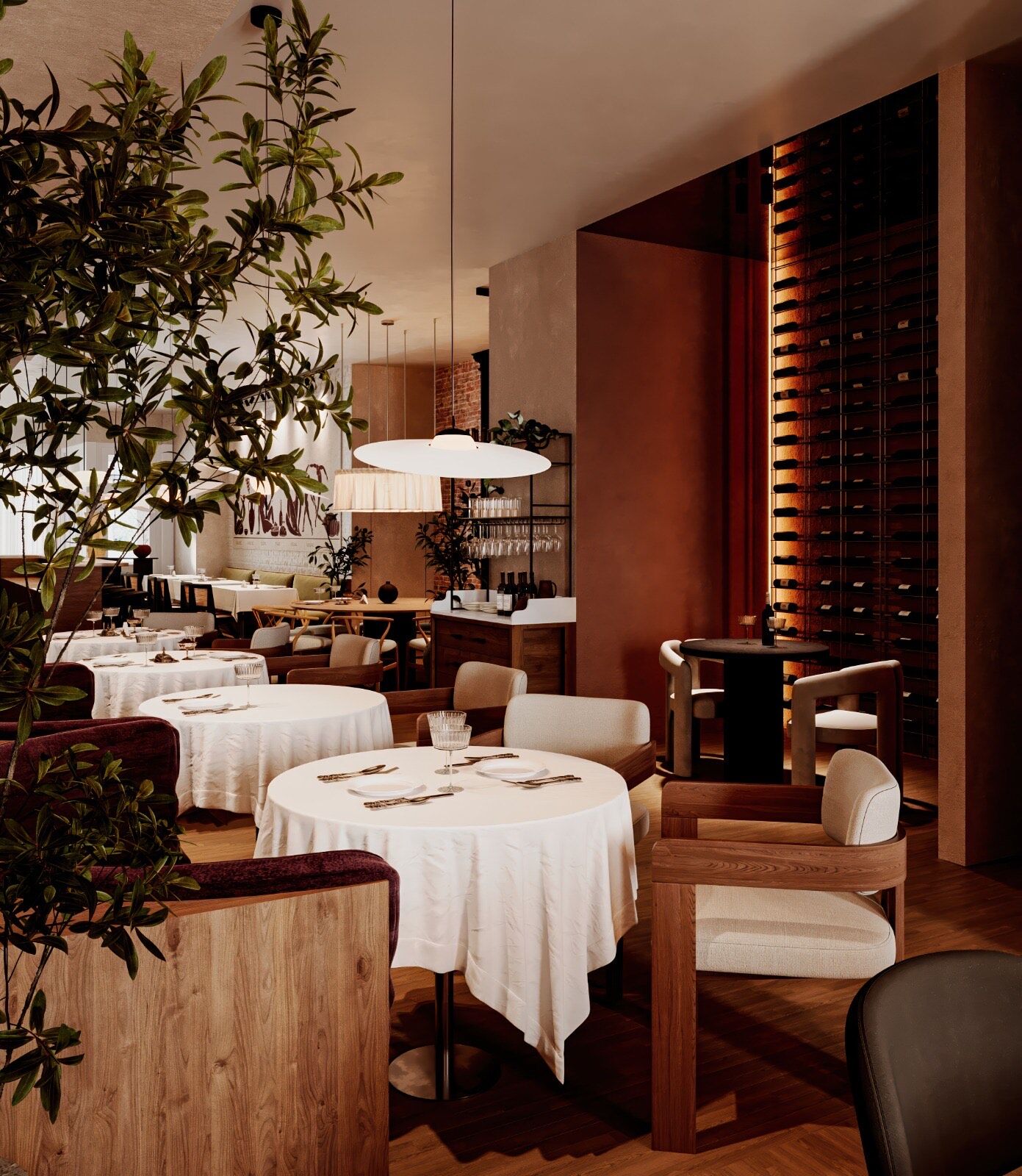
A NYC restaurant build-out runs on two calendars at once. There is the construction schedule, which you control, and the permit schedule, which you mostly do not. Owners who plan carefully for the first and improvise the second end up paying rent on a dark room for an extra quarter.
This piece lays out the filings that matter, the review clocks behind each one, and what a realistic month-by-month schedule looks like. It also covers the part that gets skipped in most guides: where design decisions block permits, and where they unblock them.
How long a NYC restaurant build-out takes
The short answer: six to nine months from lease signing to a full-service opening, and the drinks program is usually the reason it is nine rather than six.
Contractor-published benchmarks put the construction side in a tighter band. One 2026 trade guide gives a total realistic range of four to seven months: two to four weeks of pre-design, six to twelve weeks of design and DOB filing, eight to twenty-plus weeks of construction, and two to four weeks of final approvals (RDDNY's 2026 build-out guide). That math is honest as far as it goes. What it leaves out is the liquor license.
The New York State Liquor Authority's own guidance says its licensing review "currently takes approximately 22-26 weeks for most types of applications" (NYS Liquor Authority, Get a License). That is five to six months on a single permit, and it runs in parallel with everything else only if you file early. A room that finishes construction in month five and files for its license in month four opens as a restaurant without a bar.
So the honest nyc restaurant opening timeline is set by whichever finishes last: the construction or the license. Budget is a separate question with its own wide spread (the same contractor sources quote roughly $200 to $500 and up per square foot depending on kitchen scope); we covered those numbers in what restaurant interior design costs in New York.
The DOB filing decides your critical path
Most restaurant fit-outs file with the Department of Buildings as an Alteration Type 2: renovation work that does not change the building's Certificate of Occupancy. If the project does change the C of O, the filing becomes an Alt-CO (formerly Alt-1), a heavier application with a longer review. Converting retail space to a restaurant with an occupant load over 75 persons is the textbook example (Fontan Architecture on Alt-1 vs Alt-2 filings).
Seventy-five is not an arbitrary number. Any space where 75 or more members of the public gather indoors to eat or drink needs a Place of Assembly Certificate of Operation, issued for a one-year term, plus an FDNY Place of Assembly permit with an annual inspection (DOB, Place of Assembly Certificate of Operation). Cross that line and you have added a certificate, an inspection regime, and quite possibly an Alt-CO to your schedule. Design at 74 seats and you have not.
The Alt filing is also rarely alone. A working kitchen usually means separate plumbing, mechanical, and sprinkler work types under the same job number, an asbestos investigation for older buildings, and landlord sign-off on the whole package. None of these are difficult. Each one is a line on the schedule, and each is a place where a week disappears if nobody owns it.
This is why the DOB permit path for a restaurant should be settled before the lease is signed, not after. The existing Certificate of Occupancy is the first document to pull; if the space was never approved for eating and drinking, your timeline just grew by months. We wrote a separate piece on what to check before you sign the lease.
Health and liquor run on their own clocks
The health permit is the friendliest of the restaurant permits NYC requires. The Food Service Establishment permit costs $280 for most establishments, and the city allows you to open 22 days after submitting the application, even if the pre-permit inspection has not happened yet; the Health Department then inspects unannounced once you are operating (NYC Business, Food Service Establishment Permit). Treat that first inspection as opening week, because in practice it is.
The liquor license is the opposite. On top of the SLA's 22-26 week review, on-premises applicants in New York City must notify the local community board at least 30 days before the SLA will process the application (SLA, 30-day advance notice rules). Community boards meet on their own calendars, usually monthly. Miss a meeting cycle and the 30 days quietly becomes 60.
There is a bridge. The SLA processes temporary retail permits in roughly 30 days, and they are valid for 180 days, which can carry a new room from opening night to full licensure. But the bridge only works if the underlying application is already moving. If the bar carries the concept, its schedule deserves the same attention as its design; we covered the room side in what a bar build costs.
Landmarked buildings add a review, not always a delay
If the storefront sits in a historic district or the building is individually landmarked, work needs Landmarks Preservation Commission sign-off before DOB will issue its permit. For work that does not affect protected features, the standard instrument is a Certificate of No Effect, which can often be approved within 10 business days when the application is complete; LPC is legally required to decide within 30 business days once it confirms completeness (LPC, Certificate of No Effect).
The catch is the fast lane. LPC's expedited CNE can be issued within three days for specific kinds of interior work, but only when that work is not at the first or second story of a building with commercial use at the ground floor (LPC, expedited reviews). That condition excludes nearly every landmarked restaurant interior in the city. Budget the standard track, and put LPC first in the sequence, because DOB waits for it.
Where design decisions block or unblock permits
Permit problems are mostly drawing problems wearing a different coat. An incomplete set invites plan-examiner objections, and every objection is a resubmission cycle measured in weeks. A seating count that drifts upward mid-project can cross the 75-person line and convert a straightforward Alt-2 into an Alt-CO after the fact. A hood relocated in the field reopens mechanical drawings that were already filed.
A permit schedule is either designed into the project or discovered during it.
Our practice at ORÉA COLLECTIVE is to finish the full drawing set before any trade is engaged. On Sesilya, a Georgian restaurant in Park Slope, seating count, egress, and the kitchen's mechanical requirements were fixed on paper before a contractor priced the job. That is slower at the start and faster everywhere after it: trades bid the same scope, the filing matches what gets built, and nothing filed has to be amended because the field improvised. Both founders stay on every project through installation for the same reason; the person who drew the set is the person answering the contractor's question, and questions answered in a day do not become change orders answered in a month. More on how we work is at the studio page.
A month-by-month picture
Every project is its own case, but a full-service restaurant with a liquor license and no landmark complications tends to run like this:
- Month 1. Lease diligence and concept. Pull the Certificate of Occupancy, confirm the use group, measure the space. Corporate formation and SLA paperwork start now, not later.
- Month 2. Design development. File the SLA application and the 30-day community board notice. Schematic drawings become a filing set.
- Month 3. DOB filing and review. LPC first if the building is landmarked. Long-lead kitchen equipment gets ordered here or it arrives late.
- Months 3 to 6. Construction, typically eight to twenty-plus weeks depending on scope and kitchen complexity.
- Month 5. Food Service Establishment permit application, timed so the 22-day window lands just before opening.
- Months 6 to 7. Sign-offs, Place of Assembly inspection if you are over 75 persons, punch list, installation.
- Months 6 to 9. SLA determination arrives; a temporary permit covers the gap if the timing is tight.
Take the bar out of the concept, or run it on a temporary permit from day one, and the whole NYC restaurant build-out compresses toward the four-to-seven-month construction band. Add a landmark, a C of O change, or a gut kitchen and the right side of the range is the honest one.
Where does it slip? Five places, in our observation of the process: DOB objections born from thin drawings; community board calendars that add a month for every missed meeting; landlord approval cycles that were never put on the schedule; equipment lead times discovered in month four instead of month two; and scope changes mid-construction that reopen filings. None of these are exotic. All of them are avoidable with a complete set and a sequence written down before demolition starts.
The permit clocks in a NYC restaurant build-out cannot be compressed, but they can all be started early, and starting early is a design decision. If you are planning a restaurant in New York, start with a conversation.