
A restaurant mural is the one finish in a dining room that has an author. That changes the paperwork. Paint is a material you buy, but a painting on your wall carries rights that federal law gives the artist, and New York has already seen what ignoring them costs. This guide is for owners considering a mural or a large artwork: how to brief it, where it sits in the build, and how to protect and own it.
Start from the story, not the wall
Restaurant wall art chosen to fill a surface tends to look like it. A stronger brief starts from the concept (we wrote about restaurant concept development separately) and asks which part of that story belongs at the scale of a wall.
Sesilya, the Park Slope restaurant and wine bar we designed, lists custom artwork in its scope. Under the heading 8,000 Years of Wine, its project page describes a wall feature inspired by Georgia's 8,000-year-old winemaking heritage that expresses the connection between land, vine, harvest and hospitality. The gallery names the painted piece the hand-painted vine mural tracing wine from 6000 BC. It is one part of a wider art program on the same page: entrance artwork inspired by the dedabodzi, the central wooden pillar of a traditional Georgian home; a wall installation inspired by endemic Georgian wheat; and the bull. At Sesilya Bakery the art is lettering: the page describes Grandma Sesilya's handwritten khachapuri recipe as a wall feature, and the gallery shows café seating beneath a wall hand-written in Georgian.
A useful brief for a restaurant mural artist covers:
- The story, in the concept's own words, and the one idea this wall carries.
- The wall itself: dimensions, surface, what stands in front of it, and what a guest sees from the door and from a seat.
- The palette, set against the room's materials rather than chosen in isolation.
- The lighting: where the fixtures are and how the wall will read at night.
- Cleaning: what the surface will face in daily service.
- The schedule, and what else will be in the room while the painting happens.
- The paperwork: the waiver and the building owner's acknowledgment described below.
Scale, sightlines and light
Restaurant mural design is mostly a question of where people are. A dining room is read from three positions: the door, the seat and the walk to the restroom. A mural sized only for the door can crowd the two-top beside it, and one sized only for a seated guest can vanish from the entrance. In the Sesilya gallery the vine mural runs above a banquette and the tables, with a row of track lights overhead washing the wall.
Light decides whether a mural exists after dark. It belongs to the accent layer, aimed and dimmed separately from the general light; our guide to restaurant lighting design covers the layers. Plan the tables with it too. A table pushed against a painted wall puts chair backs into the work, which is a seating layout decision before it is an art decision.
Where it sits in the build sequence
A mural is painted late and planned early. Its wall has to be prepared, its light positioned and its date fixed before the trades arrive, because each depends on work done by others. At ORÉA COLLECTIVE we draw everything before a single trade is engaged, and a commissioned wall belongs in that drawing set like any other finish.
The In the making strip on the Sesilya page, captioned By hand, on site, shows the work itself. A timelapse runs from a pencil outline on the wall to a seated figure holding a glass of wine. Other tiles show a hand steadying against the wall while painting a vessel in dark red, and a jar of paint, a palette and a glass of red wine on a stepladder tray. In the footage the room's furniture is already in place around the wall. The last tile is captioned Styling the room.
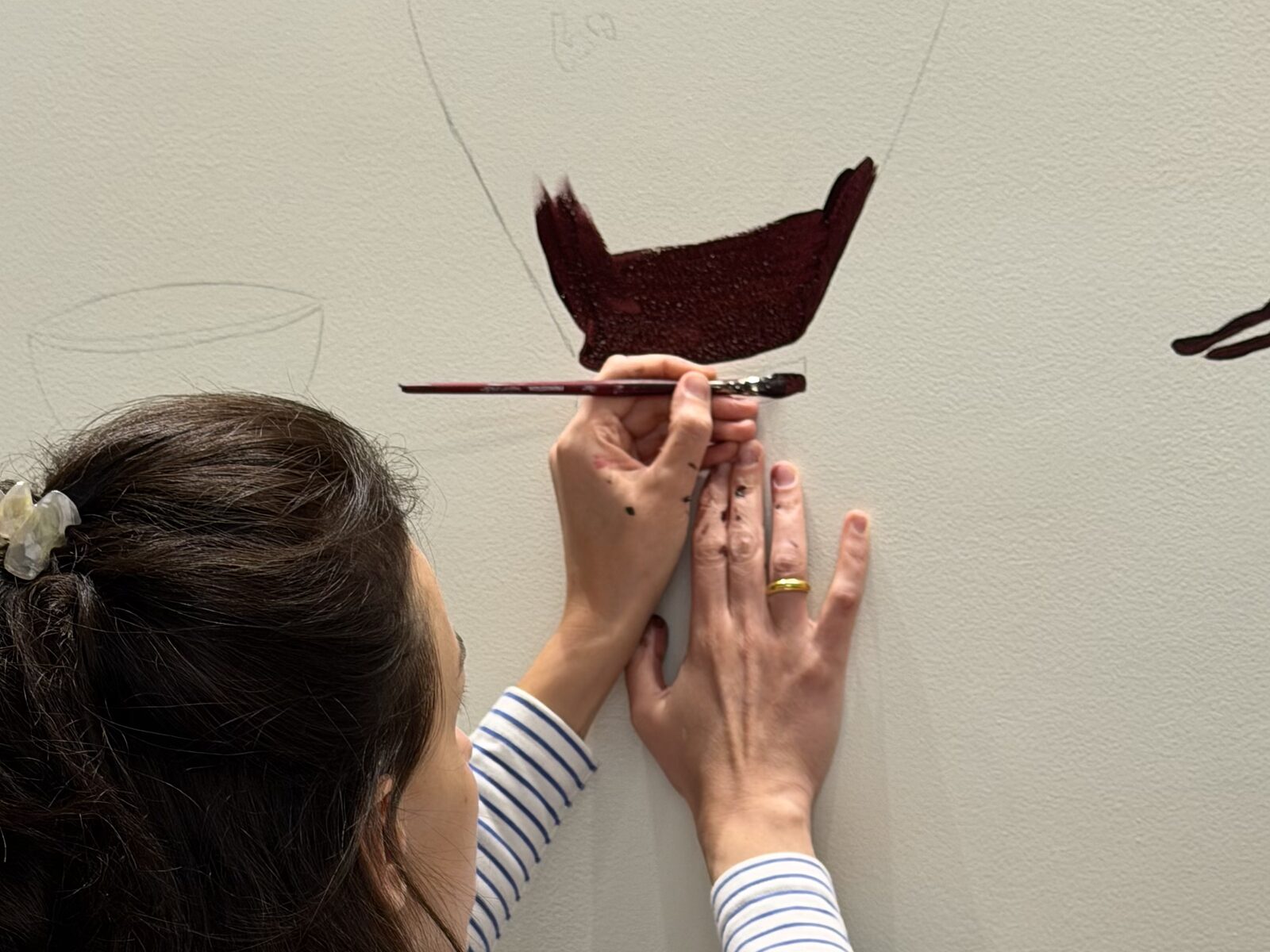
If your mural will be painted in a furnished room, put the protection of what is already installed, the hours of access and the date the wall must be ready into the artist's agreement, not into a phone call.
Surfaces near the kitchen
Health rules reach the walls. New York City's Health Code requires walls, ceilings and other interior components of rooms to be smooth, non-absorbent, light colored and easily cleanable, and it names decorative materials among the fixtures that must be easily cleanable and kept clean. The code defines easily cleanable as a material and finish from which residues may be completely removed by normal cleaning methods.
That is a hard test for a painted wall beside a pass, a dish station or a prep counter. A café mural needs particular care, because in a small café the counter and the seating can share one room. Ask the artist and your designer how the finished surface will be cleaned wherever it sits, and be most careful near food preparation, storage and washing areas. The inspection side of these rules is covered in designing for the NYC health inspection.
Who owns a restaurant mural
Paying for a mural buys the paint and the labor. It does not buy every right in the work. The Copyright Act defines a work of visual art to include a painting existing in a single copy, and the Visual Artists Rights Act (VARA) gives its author two rights that matter to an owner: the right to prevent intentional distortion, mutilation or other modification that would be prejudicial to the artist's honor or reputation, and the right to prevent any destruction of a work of recognized stature. For work made today, those rights last for the life of the author. Owning the physical work, or even its copyright, does not waive them.
The case that made this concrete in New York is 5Pointz. Artists had filled the walls of warehouses in Long Island City with aerosol art. The owner sought approvals to demolish the buildings for apartments and, while the artists' VARA lawsuit was under way, had workmen whitewash the art. The district court found that 45 of the works had achieved recognized stature and awarded the maximum statutory damages, $150,000 for each, a total of $6.75 million. In February 2020 the Second Circuit affirmed in Castillo v. G&M Realty L.P., 950 F.3d 155, holding that the temporary nature of the art is not a bar to recognized stature. The willfulness finding rested in part on the owner's refusal to give the artists the 90-day opportunity the statute provides to salvage their work, some of which was removable.
The statute offers two written tools, and a restaurant commission should consider both:
- A waiver signed by the artist. The rights cannot be transferred, but they may be waived in a written instrument signed by the author that specifically identifies the work and the uses of it the waiver covers. It applies only to the work and uses it names, so a vague clause protects little.
- An installation acknowledgment signed by the building owner and the artist. For a work that cannot come off the wall without being destroyed or altered, the rights against its destruction and modification do not apply if the artist consented to installation in a written instrument signed by the owner of the building and the author that says installation may subject the work to destruction or modification by its removal. For a work that can be removed intact, the artist's rights still apply unless the owner gives written notice and the artist fails to remove it, or pay for its removal, within 90 days (or the owner tried in good faith and could not reach the artist).
Read both the way you would read the ownership clauses in an interior design contract. This is information, not legal advice: have your attorney draft or review the waiver and the acknowledgment before the artist starts.
Read the lease before you brief the artist
The installation acknowledgment raises a point a tenant can easily miss. The statute asks for the signature of the owner of the building. If you lease, that signature is not yours to give. So the lease questions come first:
- Does the alterations clause require the landlord's consent to paint the walls or install artwork?
- Will the landlord sign the acknowledgment, in writing, before the painting starts?
- At the end of the term, must the walls be returned to their original condition? If so, you may have agreed to paint over a work the artist has rights in.
- If you sell the business or assign the lease, who takes on the mural and its paperwork?
These belong on the same list as the vent path and the ceiling height in the walkthrough before you sign.
Exterior murals: landmarks and signs
Taking a mural outside adds two regulators. If the building is a designated landmark or sits in a historic district, the Landmarks Law requires owners to obtain permits from the Landmarks Preservation Commission before doing work that affects the exterior, and the city's restaurant starter guide tells owners to allow time for that approval. Check the address before the artist draws anything.
Lettering can change the category. The Zoning Resolution defines a sign as any writing or pictorial representation painted on a building that is used to announce, direct attention to or advertise, and is visible from outside. A mural carrying the restaurant's name may meet that definition. The Department of Buildings does not require a sign permit for a sign painted directly onto a building, but the Zoning Resolution still governs its location and size. The street wall as a whole is its own set of decisions; see restaurant storefront design in New York.
A mural earns its wall when the story, the light and the paperwork are settled before the first pencil line. If you are planning a restaurant in New York and want its art to belong to the room, start with a conversation.